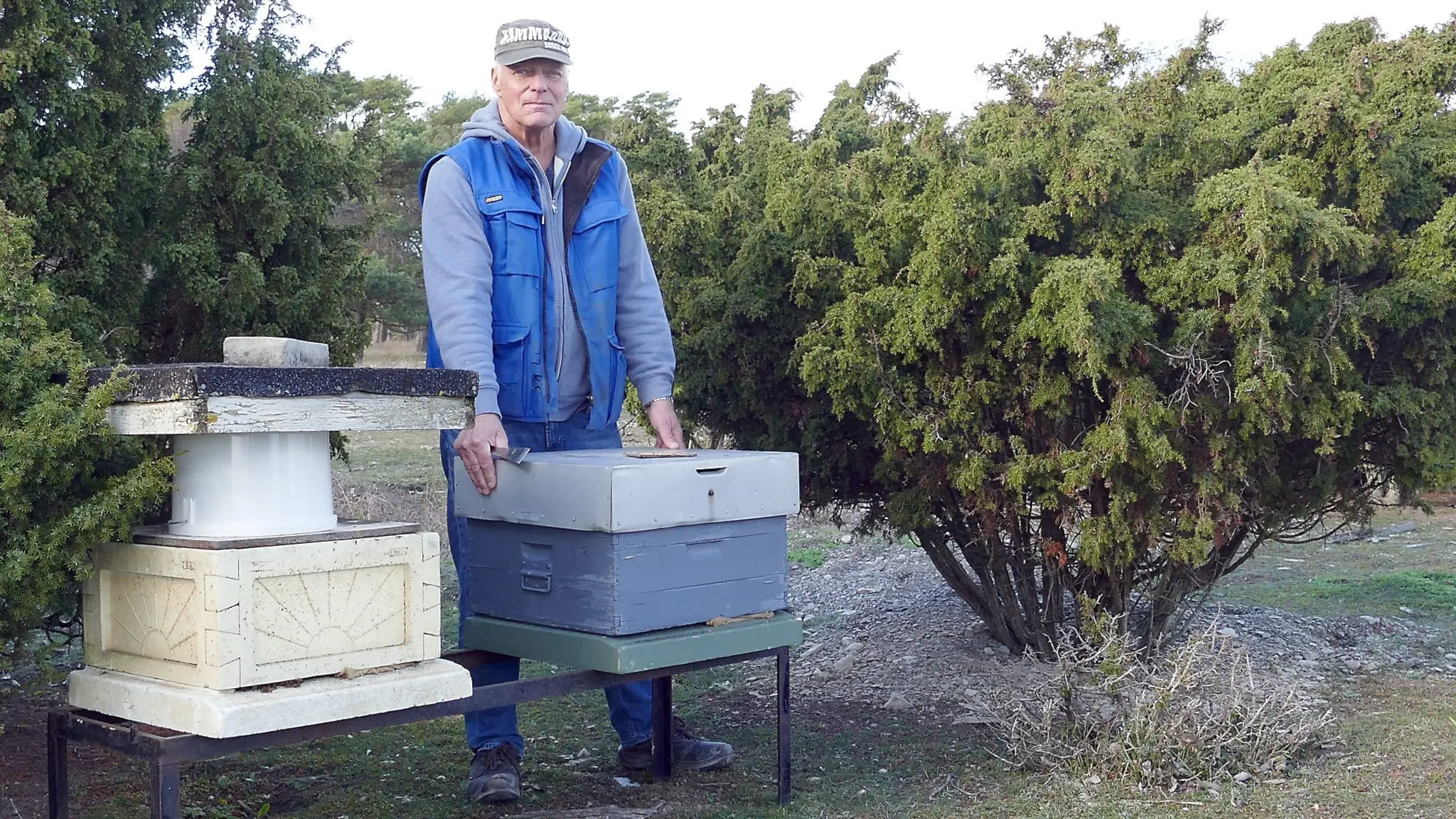
The Gotland population originated from an experiment that started around 1999–2000. Bee colonies were left untreated against Varroa destructor, which created very strong natural selection pressure.
The surviving population has since been studied for many years and exhibits several characteristics linked to the ability to live with varroa.
However, the varroa mite is only part of the problem.
A large part of the damage from varroa is linked to the viruses that the mite spreads and amplifies. Therefore, researchers have also been interested in how Gotland bees handle virus infections.
Same amount of virus – but better survival
Previous experiments have shown something particularly interesting.
When bees from the varroa-resistant Gotland population and bees from a varroa-susceptible control population were exposed to controlled infections of, among others, Acute Bee Paralysis Virus (ABPV), the virus infection itself developed relatively similarly.
Yet, fewer of the Gotland bees died.
This is an important distinction between resistance and tolerance.
Resistance, simply put, means that the host prevents or limits the parasite or pathogen. Tolerance, on the other hand, means that the individual can carry an infection or parasite load without suffering as much damage from it.
The Gotland bees thus appear to have not only developed traits that affect the varroa mite. They also seem to have developed an ability to better tolerate the consequences of certain virus infections.
The question is why.
Researchers investigated the immune system
In the new study, published in Scientific Reports in August 2026, material from previous infection experiments was re-analyzed.
Adult bees from the varroa-resistant Gotland population and a varroa-susceptible control population had received ABPV via their food. Control groups received an equivalent treatment without the virus.
Researchers then followed how the immune system reacted at different time points after infection.
Ten genes from five important signaling pathways in the bees' immune system were studied. These genes had previously been linked to reactions to virus infections.
And the virus did affect the immune system.
Several genes clearly changed their activity, especially around 24–48 hours after infection. Other genes reacted very little.
However, when researchers compared the Gotland bees with the varroa-susceptible bees, the interesting result emerged:
No statistically significant difference in the reaction of these genes between the populations could be demonstrated.
Virus tolerance exists – but the explanation seems to lie elsewhere
This result should not be interpreted as disproving previous observations about the Gotland bees' virus tolerance.
Rather, the opposite is true.
Previous experiments have shown that Gotland bees can survive virus loads better than control bees. The new study shows that this difference cannot be easily explained by altered activity in precisely these ten immune-related genes studied.
This makes the question more complicated – and perhaps also more interesting.
The explanation may lie in other genes or other biological mechanisms. It could be about the interaction between several systems, regulation at different time points, or processes not captured by studying a limited number of individual immune-related genes.
Researchers therefore point to broader molecular analyses of the material as a natural next step.
What does this mean for beekeeping?
Perhaps the most interesting perspective is that survival with varroa does not necessarily involve a single trait.
It is tempting to look for a simple mechanism: bees that groom mites, interrupt mite reproduction, or have a stronger immune system.
The Gotland population suggests a more complex picture.
A bee colony can potentially survive through a combination of traits:
mechanisms that limit mite reproduction,
behaviors and characteristics at the colony level,
ability to manage viruses,
and tolerance – the ability to continue functioning despite the actual presence of both mites and viruses.
The latter is particularly interesting.
After all, the goal of natural selection is not a mite-free or virus-free bee colony. What is selected are the colonies that manage to survive and reproduce under the prevailing disease pressure.
A result that raises more questions than it answers
The new study thus does not find the molecular "switch" that makes Gotland bees more tolerant to viruses.
But it is also a research result.
It is now possible to rule out – or at least make less probable – the hypothesis that the difference is easily explained by the regulation of the ten genes studied.
At the same time, perhaps the most important observation remains:
Bees from the naturally selected Gotland population can be exposed to virus infection and still survive better than varroa-susceptible control bees.
We know more and more about that this happens.
The truly exciting question remains:
How do the bees do it?
The study: Xinyan Ruan, Amélie Noël, Srinivas Thaduri, Joachim R. de Miranda et al., Experimental infection of acute bee paralysis virus induces differential responses of selected honey bee immune genes, independent of varroa resistance. Scientific Reports 16, 24199 (2026). Published August 5, 2026.
Read the original study:
https://doi.org/10.1038/s41598-026-65201-4